
No. A traditional dental X-ray produces a two-dimensional image. CBCT uses X-ray technology to create three-dimensional images of the teeth and surrounding structures, allowing the area to be viewed from multiple perspectives.
Successful endodontic treatment starts with understanding exactly what is happening inside and around a tooth. While traditional dental X-rays provide valuable information, there are situations where a two-dimensional image may not tell the whole story.
That is where Cone Beam Computed Tomography, commonly called CBCT, can be helpful.
CBCT technology provides a three-dimensional view of the teeth and surrounding structures, giving an endodontist additional information that can help with diagnosis and treatment planning in complex cases.
At Northwood Endodontics in Dallas, TX, advanced imaging is one of the tools that may be used to better understand the source of a dental problem and determine the best approach to treatment.
Cone Beam Computed Tomography is a type of dental imaging technology that creates detailed three-dimensional images of the teeth and surrounding structures.
Unlike a conventional dental X-ray, which produces a two-dimensional image, CBCT captures information from multiple angles to create a 3D view of the area being examined.
Every tooth is a little different, and sometimes a traditional X-ray doesn’t show everything we need to see. CBCT imaging gives us a more detailed view of your tooth, helping us look for things like an extra canal, signs of infection, or other concerns that could be causing pain or affecting how your tooth heals.
An accurate diagnosis is an important first step in successful endodontic treatment.
Traditional dental X-rays continue to play an important role in evaluating teeth, but certain conditions or anatomical features may be difficult to fully visualize on a two-dimensional image.
When clinically indicated, CBCT imaging can provide additional information that may help an endodontist:
By viewing the tooth and surrounding area in three dimensions, an endodontist may be able to identify details that help explain a patient’s symptoms or why a previously treated tooth has not healed as expected.
For patients with complex cases, CBCT imaging at our Dallas endodontic office can provide our team with additional information when traditional imaging alone does not provide a complete picture.
CBCT does not replace a clinical examination or conventional dental X-rays.
Instead, it can serve as an additional diagnostic tool when more information is needed.
Traditional X-rays provide a two-dimensional view and are appropriate for many routine diagnostic situations. CBCT provides three-dimensional information, allowing the doctor to examine an area from different angles and better understand the relationship between structures.
Because CBCT uses X-rays, it should be used when the additional information is clinically appropriate rather than as a routine screening tool for every patient.
Your endodontist will determine what type of imaging is appropriate based on your symptoms, dental history, previous treatment, clinical examination, and the specific tooth being evaluated.
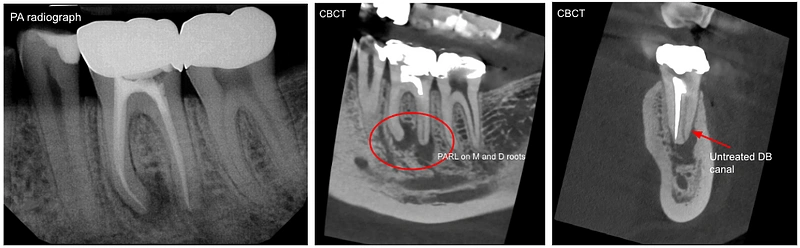
Sometimes, a tooth that has already received root canal treatment may continue to cause problems. One possible reason is an additional canal that was difficult to identify during the original treatment. If bacteria remain in an untreated area, infection may persist or develop around the root of the tooth.
CBCT imaging gives your endodontist a three-dimensional view of the tooth, which can help identify these hard-to-see areas and determine the appropriate next step.
A Recent Case at Northwood Endodontics in Dallas, TX
In a recent case, a patient came to Northwood Endodontics with a tooth that had previously received root canal treatment but was still showing signs of infection. CBCT imaging revealed an additional canal that had not been treated during the original procedure. With a clearer understanding of what was causing the problem, our team was able to locate the additional canal and begin retreatment.
No. CBCT imaging is not necessary for every patient or every root canal procedure.
Clinical examinations and conventional dental X-rays remain important parts of endodontic diagnosis. CBCT may be recommended when a three-dimensional view can provide additional information needed to better understand your tooth or plan your treatment.
If a CBCT scan is recommended, your endodontist will explain why the additional imaging may be helpful for your specific situation.
When you’re experiencing tooth pain or having problems with a previously treated tooth, understanding the source of the problem is an important first step.
At Northwood Endodontics, we combine a thorough clinical examination with advanced diagnostic technology when appropriate to get a clearer picture of what’s happening and determine the right approach to your care.
If you’ve been referred for endodontic treatment or have concerns about a tooth that has previously received root canal treatment, contact Northwood Endodontics in Dallas, TX, to schedule an evaluation.